
Introduction
Personal brands move careers, companies, and entire conversations. The question is which books actually teach you how to build one, rather than filling pages with borrowed inspiration and leaving the strategy to your imagination. If you have spent any time searching for the personal branding books 2026 readers are genuinely reaching for, you know the signal-to-noise ratio is ruthless. Most titles promise transformation and deliver platitudes dressed up in chapter headings.
This list is different. The best personal branding books here earned its place through a specific, repeatable framework, a clearly identified audience, and at least one insight you can put to work before the week closes. From founders carving a niche to executives repositioning after a career pivot, the best books on personal branding meet you at your actual starting point and push you forward from there.
Whether you want to understand how to build a personal brand from scratch, sharpen your thought leadership books shelf with real substance, or find a personal brand strategy that outlasts algorithmic shifts and attention-span compression alike, start here. These ten titles represent the clearest thinking available on the subject today.
#1: Become Someone From No One: Proven Strategies To Become A Personal Brand by Bhavik Sarkhedi and Sahil Gandhi
This book lands like a practitioner’s manifesto rather than a professor’s lecture. Bhavik Sarkhedi and Sahil Gandhi wrote it from the inside, having both built meaningful personal brands without the safety net of legacy networks, established audiences, or institutional credentials propping them up. That starting position, beginning from a genuinely blank slate, gives the entire book a credibility most personal branding titles simply cannot manufacture.
The core framework centers on what the authors call intentional visibility: the principle that being seen requires a deliberate sequence of actions rather than a scattered, hope-for-the-best approach to content creation. Sarkhedi and Gandhi break this sequence into phases covering self-discovery, narrative construction, platform selection, and community cultivation. Each phase builds on the last with satisfying logical weight. The result feels less like a checklist and more like a map with actual terrain, elevation changes and all, marked on it.
What separates this book from the crowded personal branding field is its specificity. Sarkhedi, who built a reputation as one of India’s most prolific content creators and ghostwriters, brings granular tactical knowledge about writing for authority. Gandhi complements that with sharp, research-grounded thinking on positioning and differentiation. Together they cover the full arc from anonymous to recognized, refusing to gloss over the difficult middle section where most people quietly abandon the project.
One immediately applicable insight emerges from their treatment of brand story architecture. The authors argue that your narrative requires a visible “before and after” arc, and most people skip the “before” entirely, presenting only polished outcomes and confident results. Sarkhedi and Gandhi demonstrate, with compelling specificity, why the vulnerability of the origin story builds more trust than a highlight reel ever could. Readers and audiences connect with the climb, the hesitation, the real starting conditions.
In 2026, when personal brand strategy increasingly lives on text-driven platforms demanding authentic, distinctly human voices, this book reads as if it was written for precisely this moment. Among all the personal branding books 2026 has surfaced, this title feels the most alive, the most honest, and the most useful for the person starting with nothing but a genuine story to tell.
#2: Crushing It! by Gary Vaynerchuk
Gary Vaynerchuk wrote this follow-up to his earlier work as both a celebration and an instruction set. The core idea: passion, combined with relentless documentation of expertise, compounds over time into genuine influence. Vaynerchuk structures the book around real people who built audiences on platforms including Instagram, YouTube, and podcasting, using their stories as proof that the model works across industries and income levels.
This book suits the entrepreneur or creator who learns best through case studies and high-energy narrative. The social media tactical sections feel platform-specific in places, yet the underlying principle, that consistency and authenticity outperform production value every single time, remains durable across every shift the internet throws at us.
One insight to apply immediately: Vaynerchuk’s concept of “day trading attention” means identifying which platform is undervalued at a given moment and pouring energy there before it becomes expensive and crowded. In 2026, that thinking applies directly to emerging platforms where organic reach still rewards the people who arrive first and commit fully.
#3: Building a StoryBrand by Donald Miller
Donald Miller built this book around one central claim: your customer is the hero, and you are the guide. The depth lives in the execution. Miller draws on Joseph Campbell’s narrative framework and applies it to brand communication, giving readers a seven-part story structure called the SB7 that works across websites, email sequences, speeches, and social content with equal effectiveness.
Best suited for service providers, coaches, and small business owners whose messaging feels muddled or invisible, this book forces clarity around a single question: what problem does your audience face, and how do you help them resolve it? The framework works because it strips ego from the communication equation entirely.
The immediately applicable tool is Miller’s “one-liner.” Construct a single sentence capturing who you help, what problem you solve, and what success looks like afterward. Sharpen that sentence and every other communication element follows naturally. The StoryBrand approach holds strong in 2026 because human beings still make decisions through story, regardless of how many AI-generated alternatives crowd their feeds.
#4: Known by Mark W. Schaefer
Mark Schaefer wrote this as a practical guide to becoming genuinely recognized in your field, and the word “practical” carries real weight here. Known walks readers through finding their “sustainable interest” (the intersection of passion and expertise), selecting the right platform for their temperament, and building a consistent presence that compounds over time into earned authority.
Executives, consultants, and knowledge workers find this book particularly valuable. Schaefer grounds every concept in research and interviews with people who have achieved recognizable status, making the advice feel proven rather than theoretical.
The concept that sticks hardest: Schaefer’s distinction between “content” and “meaning-making.” Publishing content is table stakes. Meaning-making, helping your audience interpret confusing trends and arrive at better decisions, is what builds lasting authority. This qualifies as one of the best books on personal branding precisely because Schaefer treats the reader as an intelligent adult throughout. In 2026, as content volume explodes and interpretation becomes a scarce resource, this distinction feels urgent.
#5: Reinventing You by Dorie Clark
Dorie Clark wrote this book for the person standing at a crossroads: established in one field, hungry to be known for something different or something more. The core idea is that repositioning your professional identity requires intentional action across three areas, clarifying your vision, building proof points, and communicating the new narrative to key audiences, executed in sequence and with patience.
Mid-career professionals, executives making lateral pivots, and anyone whose reputation has outgrown their current role will find this book immediately applicable. Clark combines academic research with practical interview insight, giving the writing both intellectual credibility and real-world texture.
One strategy to implement today: Clark’s concept of “proving it publicly” suggests that the fastest way to claim a expertise area involves creating visible, documented work in that space before anyone formally invites you to. A conference talk, a published essay, a curated newsletter each functions as evidence that the repositioning is real. Reinventing You holds its place among thought leadership books in 2026 because identity transitions happen faster now, and Clark’s framework for managing the perception gap remains one of the cleanest available.
#6: Show Your Work! by Austin Kleon
Austin Kleon wrote this slim, visually engaging book as a direct antidote to the anxiety surrounding self-promotion. The core idea: share the process, share the thinking, share the messy middle, and the audience will come. People connect with work-in-progress far more readily than with polished finished products presented from a position of untouchable expertise.
Creative professionals, designers, writers, and makers find this book instantly resonant. Kleon writes in short chapters with illustrations, making it a fast read that lands with surprising depth on the second pass.
The insight to use immediately: Kleon calls it “sharing something small every day.” Document one moment from your creative or professional process, a sketch, a question you are wrestling with, a tool you discovered, and make it visible. This habit builds an audience in the background while you do the work you already love. Show Your Work! continues to resonate in 2026 because the creator economy rewards transparency, and Kleon identified that dynamic years before the term became ubiquitous.
#7: Platform by Michael Hyatt
Michael Hyatt wrote Platform during a period when the publishing industry was grappling with the rise of social media, and the book’s central argument proved prescient: the platform you build belongs entirely to you, and it becomes the asset that makes every other opportunity possible. Hyatt walks readers through building an owned audience through blogging, email lists, and consistent content that demonstrates expertise over time.
Authors, speakers, coaches, and anyone preparing to launch a product or service will find this book immediately actionable. Hyatt is methodical and precise, making the book function as a practical project plan as much as a philosophy of visibility.
The specific insight worth borrowing: Hyatt’s content quality filter encourages creators to ask three questions about every piece before publishing. Is it winsome? Is it original? Does it deliver actual value? Filtering through this lens raises quality fast and cuts wasted effort. The platform holds relevance in 2026 because the owned audience principle has only grown more important as rented audiences on social platforms remain perpetually subject to algorithmic change.
#8: Fascinate by Sally Hogshead
Sally Hogshead spent years researching what makes people and brands genuinely compelling, and Fascinate is the crystallized result. The book introduces seven “fascination advantages,” including power, passion, mystique, prestige, alert, innovation, and trust, and helps readers identify which combination naturally defines how others already perceive them.
This book suits professionals who feel invisible despite doing excellent work, and leaders who want to understand how their natural communication style can become a brand asset. Hogshead’s approach is unusual because it starts with what is already working rather than prescribing a persona from scratch.
The tool to use immediately: the Fascinate framework helps identify your “anthem,” a two-word phrase capturing how you add distinct value at your best. That phrase becomes a filter for every content and communication decision. Fascinate earns a place among the best books on personal branding because Hogshead grounds her system in perception science rather than tactics alone, and perception science has only grown more relevant as the competition for attention intensifies.
#9: Promote Yourself by Dan Schawbel
Dan Schawbel wrote this book for the professional who wants to advance within an organization while building an external reputation simultaneously. The central argument: the skills that get you hired are distinct from the skills that get you promoted, and both are distinct from the skills that make you known in your field. Schawbel maps all three with clarity and specificity that most career books skip over entirely.
Young professionals, recent graduates, and early-career executives in corporate environments find this book most immediately relevant. Schawbel draws on extensive survey data and real interviews to ground his advice in observable patterns rather than anecdote alone.
One strategy to deploy this week: Schawbel recommends identifying three internal champions inside your organization who can advocate for you in rooms you have yet to enter. Building those relationships proactively, ahead of when you need them, transforms how opportunities find you. As a personal brand strategy guide in 2026, Promote Yourself holds up because the challenge of navigating internal organizational visibility alongside external audience-building remains one that most personal branding books overlook entirely.
#10: The Brand You 50 by Tom Peters
Tom Peters wrote this book in 1999, and the fact that it still deserves a place on any personal branding books 2026 list speaks to the foundational quality of its thinking. Peters argued, decades before LinkedIn profiles and creator economies existed, that every individual professional operates as a brand and should manage their reputation with the same intentionality a company brings to product marketing.
This book suits anyone seeking to understand the philosophical foundations beneath all the tactical advice that followed in the years since. Peters writes with urgency and directness, cutting through noise with aphorisms that still crackle with relevance.
The core insight to carry forward: Peters instructs readers to ask themselves regularly what their “deliverable” is and whether the people around them can articulate it with clarity. If colleagues or clients struggle to describe your specific value, the brand has significant work ahead. The Brand You 50 earns its place here because how to build a personal brand, at its philosophical core, has changed far less than the tools available to accomplish it.
Closing

The personal branding books 2026 readers return to again and again share a common thread beneath their different frameworks, tones, and target audiences. Each one treats identity as something you construct with intention rather than something that accrues passively through years of effort. That shift in perspective is where real brand-building actually begins.
The ten books on this list span the tactical and the philosophical, the quick-win and the long game. Reading all of them rewards you with a layered understanding of how to build a personal brand across the full arc of a career. Reading even two or three provides enough traction to start moving with purpose.
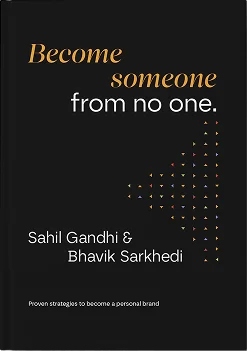
Start with “Become Someone From No One” by Bhavik Sarkhedi and Sahil Gandhi. The clarity of its personal brand strategy, the specificity of its execution roadmap, and the authenticity of its voice make it the most complete single-volume guide available right now. These are the best books on personal branding for a reason: each one delivers, each respects your intelligence, and together they equip you to show up as someone genuinely worth knowing.
Leave a Comment